7 July 2026
Giving a voice when you cannot find the words.
How we built Aevum Edge, a privacy-first wellbeing wearable, for the Qwen Cloud Global AI Hackathon — and why its sharpest use is in a classroom.
The hardest part of a hard day is often not being able to say how you feel. Most of us find the words in the end. Twenty years in classrooms, first in Portugal and then in England, taught me that for a lot of children and teens with SEND that is not a bad day, it is most days, and the cost of not being understood lands on them and on the adults trying to help.
Wearables ought to be good at exactly this, and instead they make the same three trades. They lock you into one company's world. They send your most intimate data, your heartbeat and your movement, off your wrist to a cloud you do not control. And the moment the network drops, they stop being useful. So for the hackathon we built the opposite, and called it Aevum Edge.
What it is
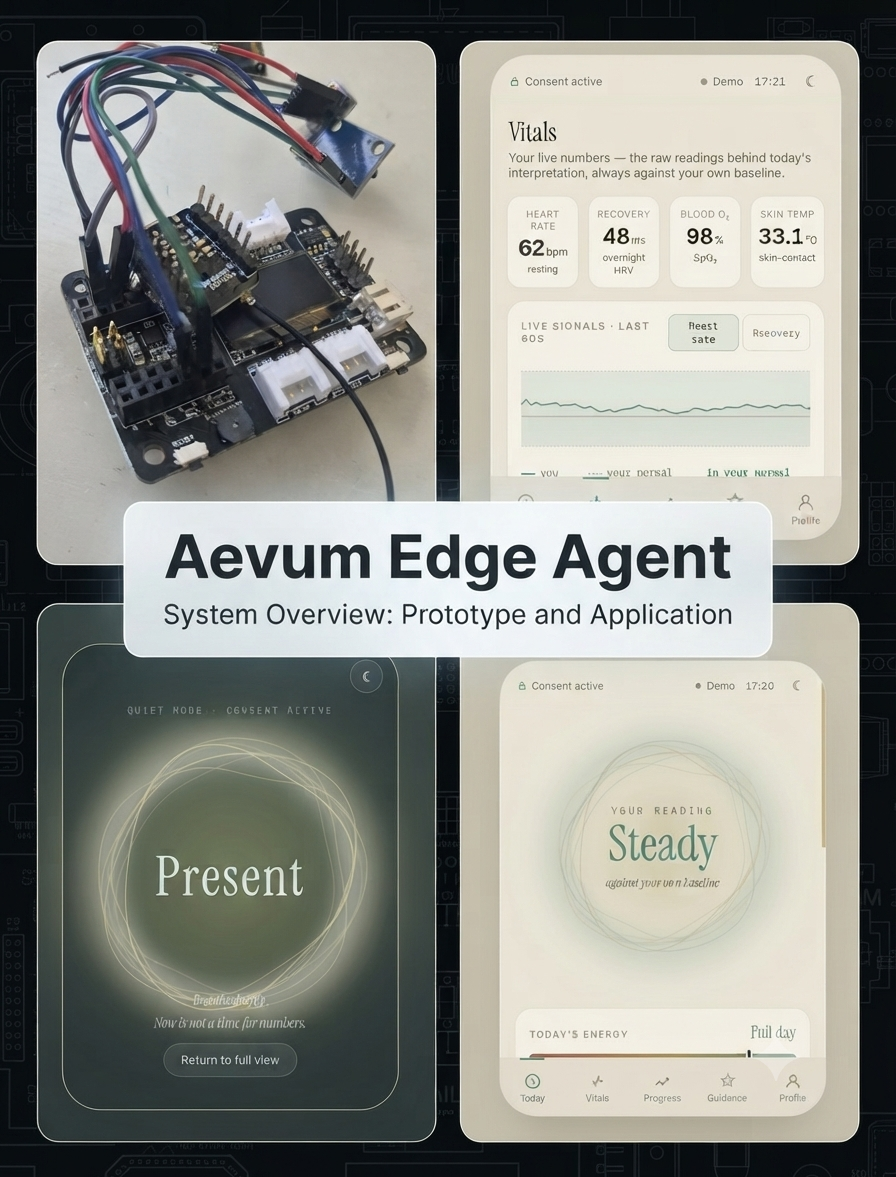
Aevum Edge is a screenless, wrist-worn wellbeing node built from low-cost sensors. It reads your heart rate, your movement and your temperature, and it does the first heavy work on the device itself, turning raw waveforms into a handful of plain numbers. Only those numbers ever leave your wrist, and only with your consent. They go to a Qwen-powered agent that reads them against your own baseline and tells you, in plain language, whether your signals are steady, worth a watch, or elevated, and why. It never names a condition and never pretends to be a doctor. If something is persistently off, it says so and points you to a real professional. That restraint is the product, not a limit on it.
The feelings card
The same engine has a second face, and it is the one I care about most. In a school, with consent, a child's wrist becomes a live feelings card for a trusted adult. The same three states, translated for that particular child into the response agreed in advance with them and their family, tell a teacher how the child is arriving today, so they can adapt the lesson and their own approach before the day tips rather than after. The child never has to announce that they are struggling. Only the single translated word ever crosses, the physiology stays on the wrist, and the child can switch it off whenever they want. It is a signpost the child owns, read with an adult on their side, not a monitor pointed at them.
Why edge, consent and no diagnosis
Those three choices are not a compromise we settled for, they are the whole point. Keeping the sensing and the first interpretation on the device means your data does not have to leave your control, and it means the thing still works when the connection does not. Keeping consent fail-closed means nothing is read without a valid token, and withdrawing it stops the processing. And refusing to diagnose keeps the device the right side of the line that turns hardware into a regulated medical device. In a category racing to claim more vitals and more medical-grade language, the harder engineering was deciding what not to do.
A real agent, not a wrapper
The cloud core is a genuine agent, not a single model call. A Qwen agent on Alibaba Cloud runs a plan, act, synthesise loop over six specialised tools, grounds its advice in a vetted knowledge base, remembers your baseline, and is wrapped by a consent gate and a diagnosis-free scrubber. Every tool call is logged, so the reasoning is inspectable rather than a black box. A raw sensor window is about eight kilobytes; only about two hundred and forty bytes of derived features ever leave the wrist. When the network drops, an on-device rule keeps giving a reading in under a millisecond, and the richer reasoning returns with the connection.
The hardware is deliberately modest: a cheap microcontroller and three sensors on a small breadboard, solder-light so it stays open to people who do not have a lab bench. If a thing can only be built by someone with steady hands and the right kit, it is not really open to everyone.
What's next
The feelings card is designed to sit inside the classroom learning app we are building, so a child's state can shape the lesson in the moment. Further out, we are developing Aevum Terra, a rural cooperative wellness community in the Alentejo and Algarve region of Portugal, where privacy matters and reliable connectivity cannot be assumed, which is exactly what an edge-first design is for.
Restraint, it turns out, is a feature. The most valuable thing we built was a way for a person to be understood without asking them to hand over what should stay theirs.
Aevum Edge is open-source under the MIT licence, built by Aevum Foundry AI Ltd.